
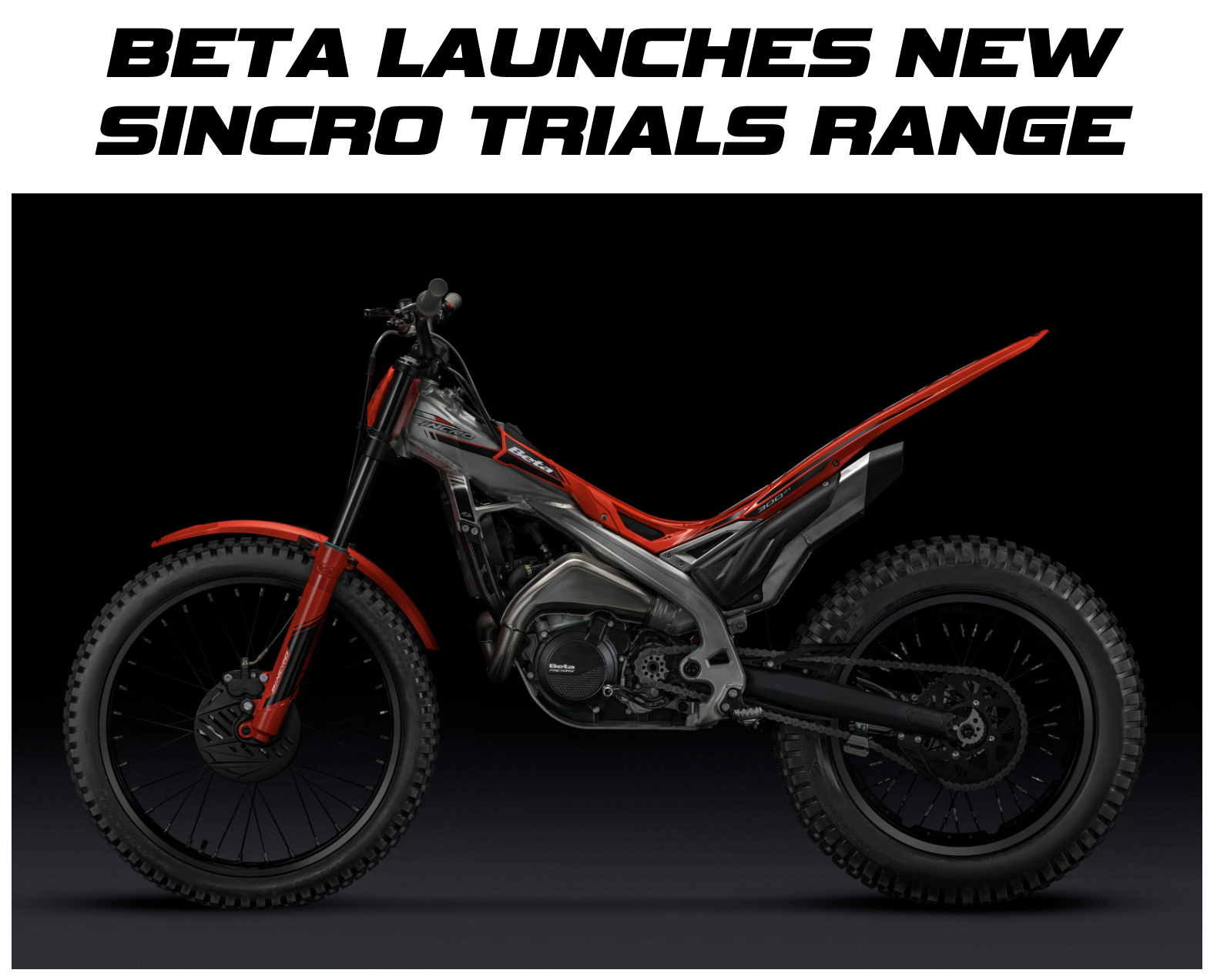
For many years, Beta has been the leader in trials technology, competing at the highest of levels world-wide. Since 2009, the EVO name has been synonymous with performance and rideability, but today, the EVO name has been retired, to make way for an all-new trials range - SINCRO.
SINCRO: not a simple evolution, but a true conceptual revolution. A project created to deliver perfect SINCROny between rider and bike, turning every input into pure control and fluidity.
Key highlights:
- All-new hydroformed aluminium backbone frame with integrated tank: lighter, more precise handling.
- Completely redesigned engine for a smoother, more immediate response.
- New, sleek and modern design that refines the bike’s proportions.
- Maximum RideAbility: instinctive feedback and class-leading balance in every situation.
- Frame, suspension, weight distribution, and engine response—every element has been reengineered to foster an instinctive rider–machine dialogue.
The new SINCRO 2T range will be available in 125, 250, 300, and 300 Super Smooth (SS), temporarily coexisting with EVO in select displacements.
| Model | Type | Summary |
|---|---|---|
| EVO 80 2T Junior/Senior | 2-stroke | The 80cc 2T units remain under the EVO name. The Junior version is by far the easiest bike to use for young riders new to the sport. The Senior version, on the other hand, is an intermediate step between the smaller bike and the bigger 125 2T model, sharing the same wheel size with the latter while keeping the intuitive manageability of the 80cc 2T engine. |
| SINCRO 125 2T | 2-stroke | The smallest bike in the range. Light and agile, this is perfect for young riders moving up from lower classes and making their first forays into more serious competitions. The engine delivers enough performance to overcome any obstacle safely, while still being fun and easy to handle. |
| SINCRO 250 2T | 2-stroke | The 250 2T is the best bike for riders looking for an agile and easily controllable 2-stroke, with a more docile temperament and with slightly less power and torque than the range-topping 300 2T model. The SINCRO 250cc is ideal for the amateur looking for class-beating performance combined with manageable power and impeccable rideability. |
| SINCRO 300 2T | 2-stroke | The 300 2T is the range-topping model. A bike for lovers of big capacity engines, with impressive torque at all engine speeds, and the perfect base for competing at pro levels. The frame and the engine have been developed to maximise the ability of the bike to overcome even the most challenging obstacles or the most technically difficult trials. The ideal solution for expert riders looking for a bike with class-leading performance, while being intuitive and easily manageable. |
| SINCRO 300 2T SS (“Super Smooth”) | 2-stroke | With SS standing for “Super Smooth”, this is the model with the broadest appeal in the whole 2T range. A bike that is extremely fun to ride with all the main traits of the biggest Beta engine - the 300cc 2T - but with more tempered power delivery at low to mid-engine speeds than the standard version which, together with a series of other minor tweaks, make this an even more enjoyable and easy-to-use machine for the less experienced rider. |
| EVO 300 4T | 4-stroke | The 300 4T makes a comeback in the updated EVO model. It remains the ideal compromise between performance, engine docility and overall ease of use. This engine embraces a completely different approach to riding than its 2T siblings. With plenty of torque and linear, extremely progressive power delivery, this is the perfect bike for the amateur looking for a machine suitable for less challenging competitive use and motorcycle mounting climbing. |
Below is a summary of the 300 2T model, with more to come
FRAME
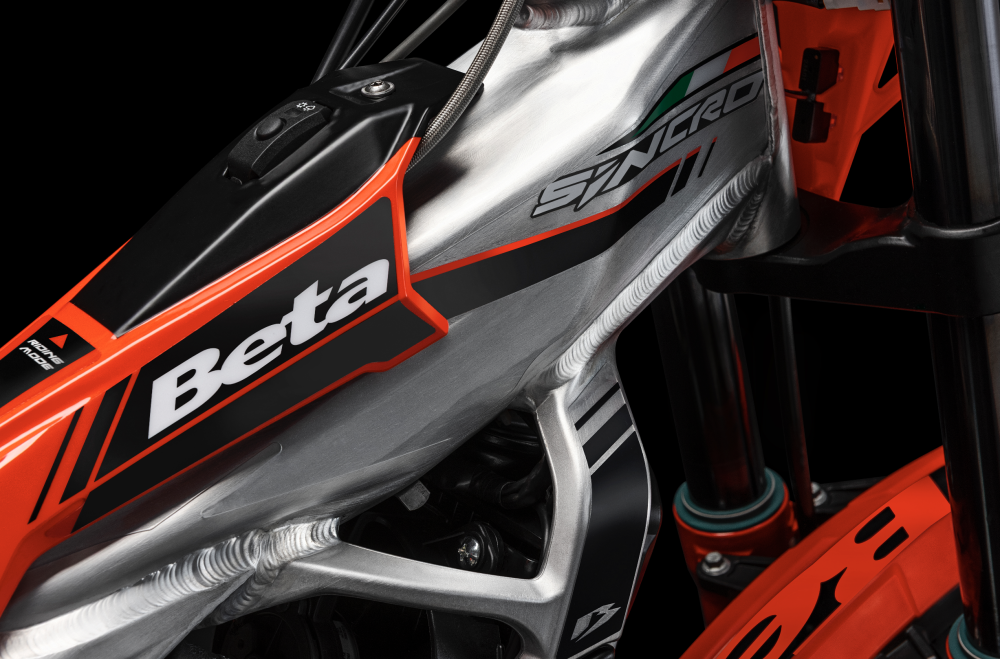
While the SINCRO frame retains Beta’s signature hydroformed aluminium backbone design, with an integrated fuel tank, it has been completely updated. The frame geometry has changed, along with new forged front and rear sections, strategically located to improve handling.
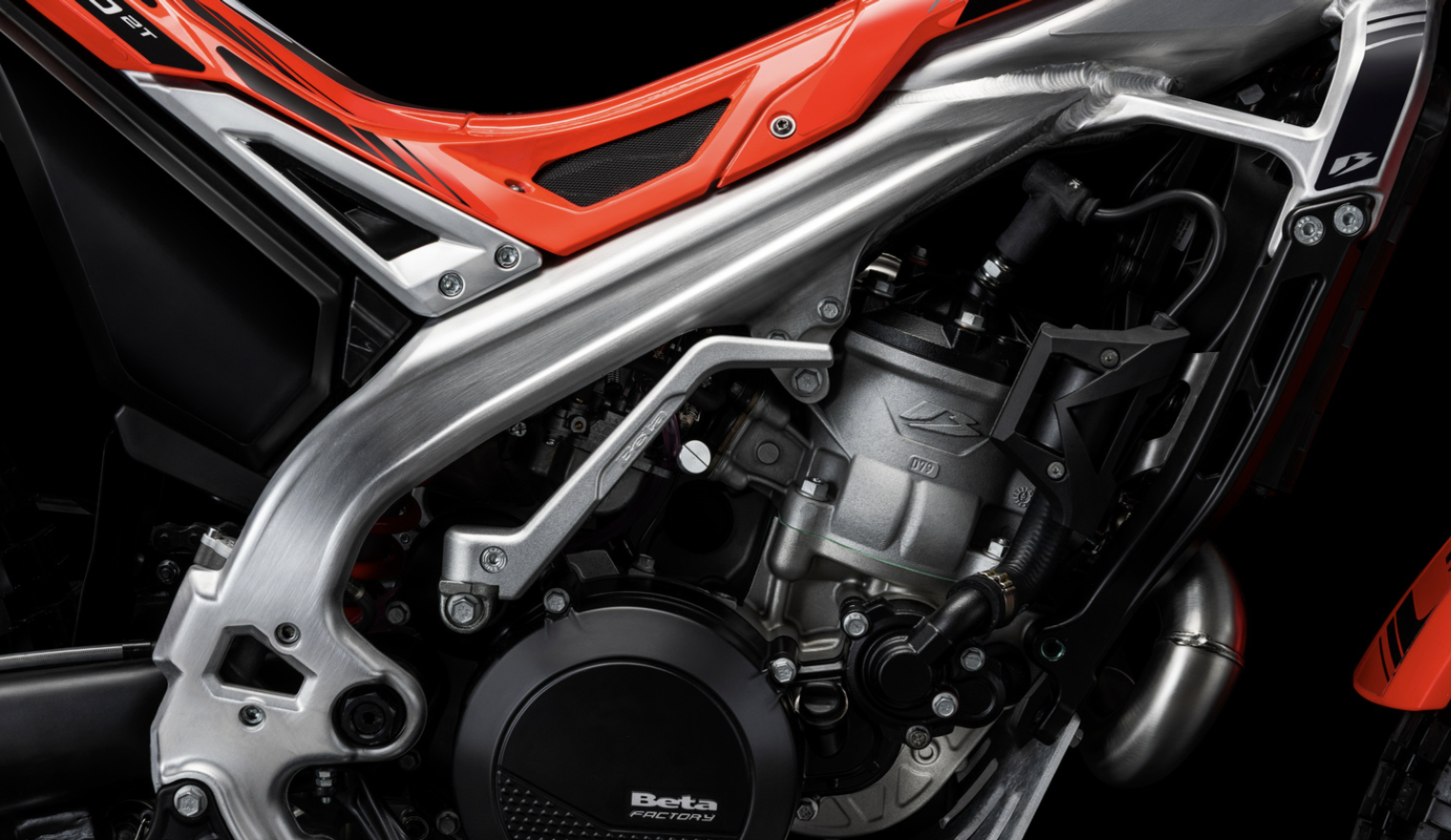
The new frame was reinforced in the steering tube area, to strengthen the structure, reducing welds and connecting everything to the front forged element on the frame. The radiator now has a new fixing system and is anchored to new forged arms.
The engine maintains its role as a structural element, but the fixing points to the frame have been changed, resulting in increased flexural and torsional stiffness compared to the previous generation.
The SINCRO project has moved in the direction of creating an even leaner bike than Beta’s previous trial range, reducing the vehicle overall dimensions and weight, to achieve class-leading performance and manoeuvrability.
SUSPENSION
Alongside the new frame, an all-new swingarm has been developed to match both its style and performance. Thanks to a redesigned layout and advanced processing techniques (tube swaging followed by mechanical forming in moulds), the swingarm is 100 grams lighter, yet stronger than before. The need for reinforcement welds at high-stress points has also been greatly reduced. Its variable diameter design further improves handling precision.
Suspension updates on the new SINCRO played a decisive role in meeting the high standards set by the engineers and test riders. Both the fork and rear shock have been significantly revised to enhance its obstacle-clearing ability and deliver a more responsive, rider-focused feel.
Fork: The front suspension has been refined in both function and hydraulics, with the inner spindle distance reduced by 10 mm. The fork sheaths feature a new design and improved internal machining, while a shorter stem reduces weight and improves agility in aerial manoeuvres. A lighter 5W oil is now used, paired with revised hydraulic settings. As a result, the fork is more versatile, more sensitive to adjustment inputs, and better able to adapt to different riding styles and conditions.
Rear shock: The shock absorber top mount has been repositioned and features new linkage mounts, giving it a more progressive response while also centralising mass. Travel remains unchanged. Its lightweight aluminium body retains extension and spring preload adjustments, but now also features a gas inflation valve, simplifying maintenance.
CHASSIS
Beyond the new frame and suspension changes, several other components have been reengineered to make the SINCRO a truly competitive package:
Rear brake: The pedal pivot point has been repositioned to deliver stronger, more controlled braking—particularly effective on steep descents.
Triple clamps: Completely redesigned with a modern, refined look. Forged as a single piece, the new clamps are both robust and visually striking, reinforcing the model’s distinctive identity.
Wheel hubs: Updated hubs provide more precise handling and faster response when changing direction, improving both performance and appearance.
Electrical system and regulator: The electrical housings have been repositioned for a cleaner fit within the new chassis layout, reducing interference with movement and simplifying maintenance. The regulator has also been relocated, ensuring greater electrical stability and protection against overloads in all conditions.
Airbox: Now seamlessly integrated into the tapered frame design and supported by two forged aluminium brackets with a high-quality finish. The airbox is now made from two coupled sections instead of a single block, improving both functionality and fit.
All of these updates come together visually with completely new bodywork. The panels are slimmer and less intrusive, giving the bike a more streamlined appearance while still offering ample surface area for striking new graphics.
Finally, in keeping with the previous model’s DNA, the tank cover continues to house the map switch button. It now sits under a new co-moulded lid, a construction technique that combines durability with premium styling.
ENGINE
For years, Beta’s previous generation of Trial bikes has dominated competitions worldwide. To stay ahead, the Tuscan manufacturer has taken a bold new direction with the SINCRO—and the engine reflects this shift.
The design is completely new. Only the bore and stroke (79 x 60.5 mm, 300 2T) have been carried over from the EVO models, everything else has been re-engineered. Visually, the first major change is the new crankcases, with the kickstarter now positioned on the right and the chain drive on the left.
Centralising mass was a key development goal, aimed at improving handling across all obstacles. To achieve this, engineers reduced the flywheel’s diameter, weight, and inertia, while increasing those of the crankshaft. The crankshaft/swingarm pivot axis was also lowered by 2 mm for a more compact centre of rotation.
The cylinder is all new, and transfer port geometry has been completely revised through precise flow analysis, optimising intake and exhaust paths.
The intake system marks one of the biggest departures from the past. The reed valve pack is now mounted directly on the cylinder, eliminating intermediate passages. This shortens the connection between carburettor and reeds, moving them closer to the piston area where pressure pulses begin. By bypassing the upper petal, the design allows the reeds to open earlier, making better use of resonance waves generated in the cylinder and crankcase as the exhaust, transfer, and intake phases overlap.
The result is a faster, sharper engine with a much more precise throttle response. Riders will feel a stronger connection to the bike, gaining traction exactly when needed. Additional benefits include fewer power pulses at idle and low speeds, along with cleaner combustion.
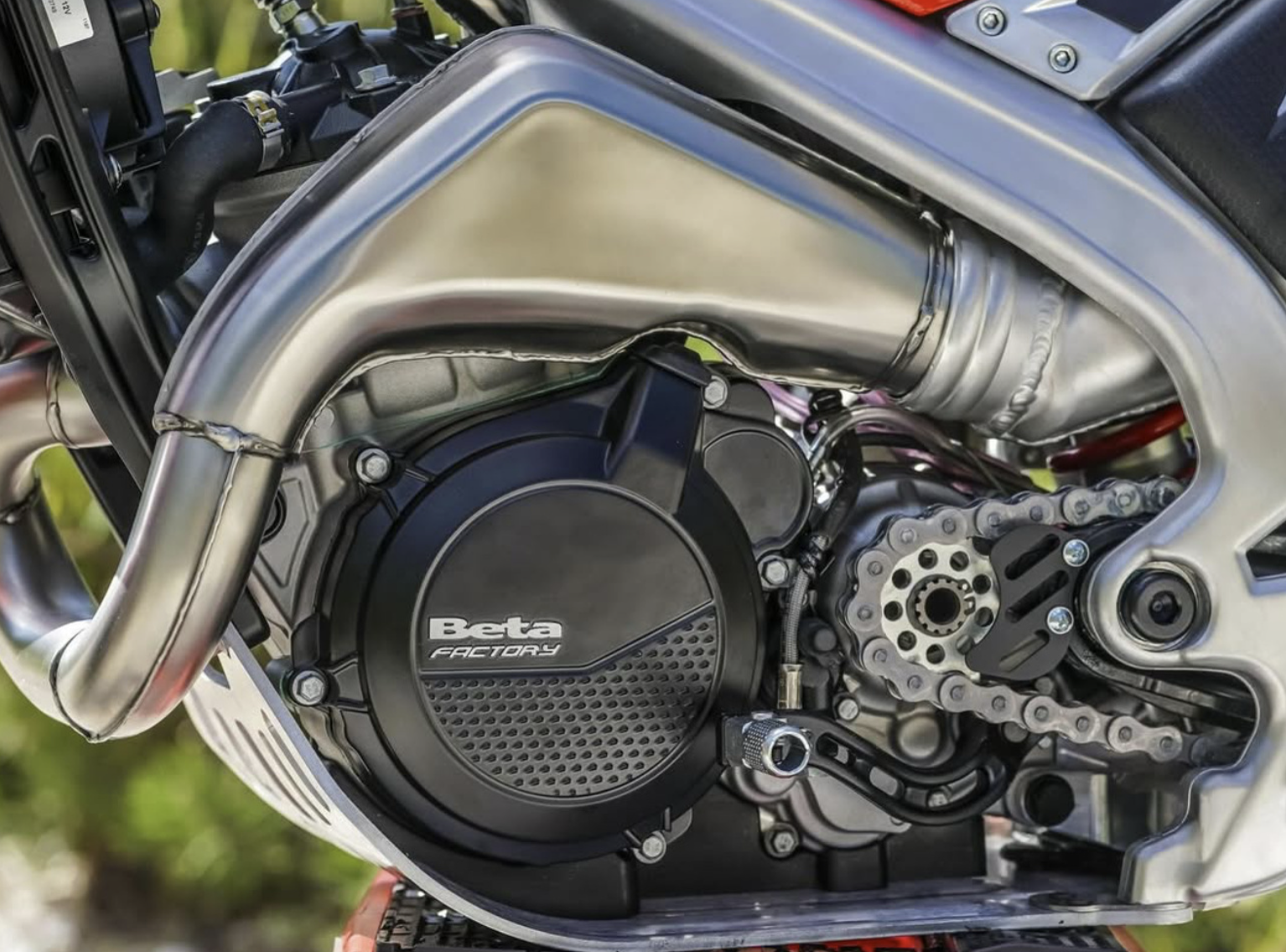
The cylinder head is now made from a single block, while the new crankcase covers are cast in lightweight magnesium alloy to reduce weight without compromising strength. Finally, the exhaust system has been reworked: it retains the characteristic expansion chamber but has been redesigned to perfectly complement the new engine, ensuring benchmark performance.
Other major updates include the option to install an electric start system (available as a Factory Kit, not for the 125cc). Importantly, fitting the kit later requires no aesthetic changes to the crankcase covers, which have been redesigned with new geometries to match the SINCRO’s fresh styling. The battery for the kit is neatly housed behind the headlight mask, giving riders the choice between electric start or traditional kickstart.
ENGINE COOLING
The entire cooling system has been completely redesigned with a cleaner, more integrated layout.
All coolant passages are now built directly into the engine, eliminating the need for external piping.
The radiator is more compact than before but delivers the same cooling performance. A new quicktilt feature allows the radiator to pivot forward on its lower pins: simply loosen the top knob, and the upper tray swings out to expose the cap.
This system offers several benefits:
- Improved aesthetics, as only the flat radiator surface is visible.
- Better protection, since the cap is hidden and shielded from impacts or falls.
- Easier access for maintenance.
The water pump and coolant passages have also been re-engineered. A nylon insert inside the clutch cover now links the pump outlet to the cylinder inlet, ensuring no coolant comes into contact with the clutch housing—without relying on external hoses.
The new centrifugal pump is smaller and more efficient than the one on previous models. Its redesigned spiral housing and closed impeller improve fluid flow through the engine’s internal channels, further boosting cooling efficiency.
CLUTCH & GEARBOX
The lower half of the engine has been completely redesigned, featuring new geometry and a more compact six-speed gearbox. The primary transmission ratio has also been revised to work seamlessly with the new engine and gearbox.
The clutch is entirely new, adopting diaphragm springs (as used on the Beta Enduro range) instead of traditional helical springs. With dedicated dimensions and components, the clutch pack remains compact while still using the same number of discs as the previous generation—though they are now smaller in diameter and made from new materials. This solution allows for a slimmer crankcase while still delivering excellent performance under stress.
Despite its reduced size, the clutch provides:
- Softer, more controlled lever feel.
- Greater precision and modulation.
- Improved engagement and disengagement.
- Higher torque transmission capacity.
To suit different riding preferences, the clutch offers three spring preload settings, easily adjusted through a simple mechanical procedure. A new clutch actuator design also ensures consistent pressure on the piston via a dedicated spring, guaranteeing stable performance even under heavy use by professional riders.
Overall, these updates make the engine significantly more compact, shaving nearly 800 grams compared to the previous model. Performance has also taken a step forward, with a wider usable powerband, sharper low-speed response, and improved handling—all while maintaining top-level output.
Additional information on the remaining models within the SINCRO range will be shared following EICMA in early November.
SINCRO models are expected to arrive in Australia in early 2026.